
Memory Is Now a Compliance Surface
Published on September 16, 2026

For the first two years of the enterprise AI wave, the question in every boardroom was "Can the model answer the question?" That question is settled. Frontier models answer almost anything, fluently, instantly, and with total confidence.
In healthcare, financial services, insurance, defense, and government, that is precisely the problem. The question that now decides whether an AI system ships or gets killed in legal review is different: "Can this system remember the right context and without exposing protected data, without breaking retention rules, without creating audit gaps, and without confidently telling us something that isn't true?"
That is a memory problem. And memory, in a regulated environment, is not a feature. It is a compliance surface.
What "memory" means when the data is regulated
In consumer AI, memory is a convenience: the assistant remembers you prefer short answers. In a regulated enterprise, memory is everything the system carries from one interaction to the next. This includes history, role and profile context, retrieved records, long-term facts, multi-step session state, and structured context tied to a patient, a claim, a matter, a customer, or an investigation.
Every one of those paths touches PHI, PII, financial records, or investigative material. Which means every storage path and every retrieval path is a place where the organization can fail an audit.
The industry has converged on a reasonable checklist for evaluating memory infrastructure. Any serious buyer should demand all eight:
- Privacy and data minimization — store only what is necessary; redact before persistence
- Auditability — what was stored, who accessed it, when, why, and what the model did with it
- Retention and deletion — time-based expiry, legal hold, case-level and user-level purge
- Data residency — regional deployment, tenant boundaries, bring-your-own-cloud
- Access control — permission-aware retrieval enforced at the data layer, not the prompt
- Encryption and key management — in transit, at rest, customer-managed keys
- Model governance — control over what can be written into memory and what can be recalled
- Tenancy and isolation — memory partitioned by user, team, business unit, customer, or case
This is a good list. Most vendors now claim most of it. And yet regulated deployments keep stalling in legal review. Why?
The gap in the checklist
The eight controls above all answer one question: is the data governed? They say nothing about a second question that matters just as much in a regulated setting: is what the system remembers actually true — and does the system know when it doesn't know?
Consider how memory actually fails in practice.
A clinical assistant is asked whether a patient has a penicillin allergy. The allergy was recorded in 2019. A 2023 note says it was ruled out after testing. Both records are in the memory store. A recall-optimized system returns whichever embedding scores higher and answers confidently. It was "governed" and the data was encrypted, access-controlled, and logged. It was also wrong, and the audit log will faithfully record that the AI recommended a contraindicated drug.
A bank's internal copilot is asked for the current KYC status of a counterparty. The memory holds a status from March. It was updated in June, but the June update lives in a different system that was never ingested. The assistant answers with the March status. Nothing in the eight-point checklist would have caught this.
A defense manufacturer's engineering assistant is asked for the approved revision of a wiring specification. Two of the twenty-six documents in the data pack disagree. The system picks one. Nobody knows there was a conflict until the part fails inspection.
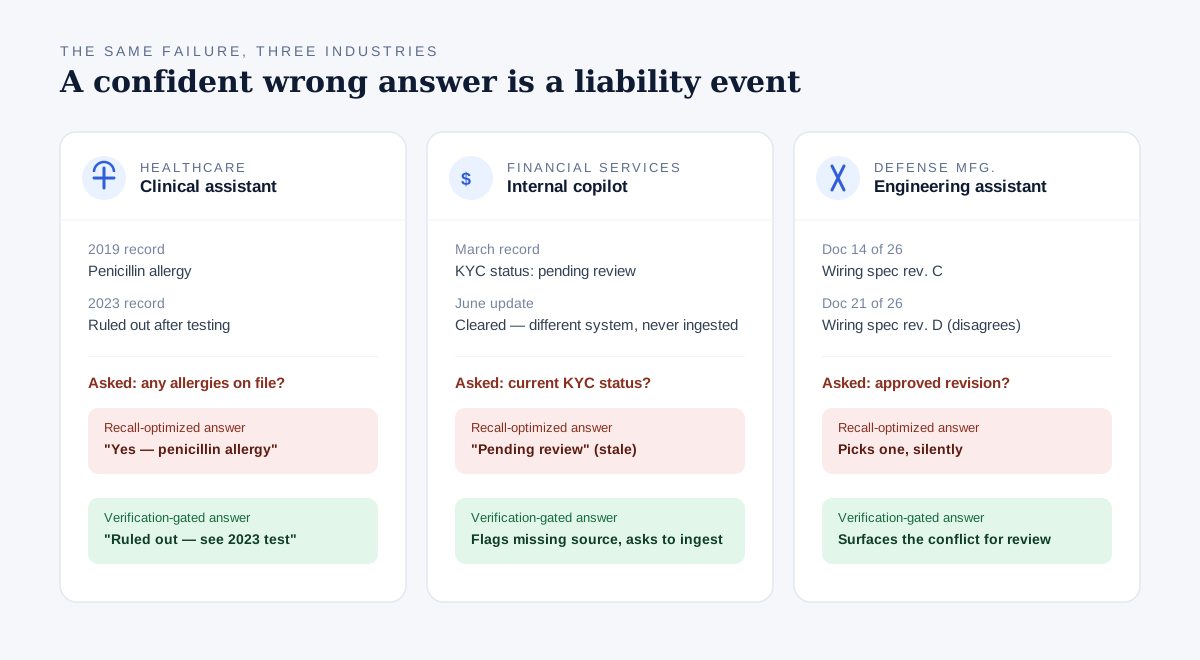 The same failure repeats across every regulated function — a confident answer built on the wrong version of the record
In every case, the memory layer passed its governance review and failed the organization anyway. The failure mode is not leakage. It is confident retrieval of contradictory, stale, or insufficient evidence, and in regulated industries, a confident wrong answer is not a bad user experience. It is a liability event.
Vector similarity cannot detect a contradiction. Recall-optimized architectures are built to always return something. And no amount of encryption makes a stale fact current.
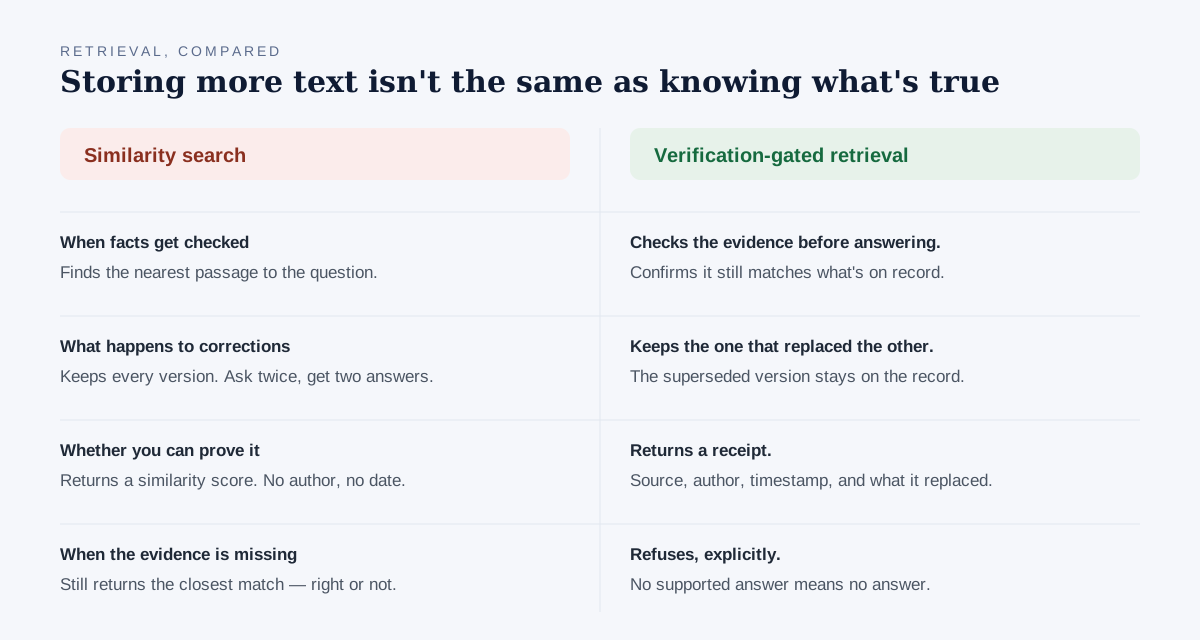 Storing more text doesn't make an AI more right — search finds the nearest passage, not the true one
Memuron: memory built for precision, not just governance
 Verification is the missing handshake between what an AI system recalls and what a regulated organization can stand behind
AlphaNimble built Memuron on a single premise: in regulated environments, the memory layer must be verification-gated — it must prove an answer is supported before it returns one, and refuse when it cannot.
Three architectural primitives make that possible, and each maps directly onto the failures above.
Verification-gated retrieval with refusal. Before any context reaches the model, Memuron checks whether the retrieved evidence actually supports the query. If the evidence is insufficient, conflicting, or absent, the system says so explicitly, rather than returning the nearest plausible match. On adversarial benchmarks designed to measure exactly this (questions where the correct answer is "the data isn't there"), Memuron scores 96–100%. Recall-optimized memory layers score around 50%. The gap is architectural: refusal cannot be bolted onto a system designed to always return a result.
Write-time contradiction resolution. When a new fact conflicts with an existing one, Memuron does not overwrite and it does not silently keep both. It links the two, timestamps the conflict, and surfaces it on every relevant query until it is resolved. The penicillin case, the KYC case, and the wiring-spec case are all caught at ingestion before a human ever asks the question.
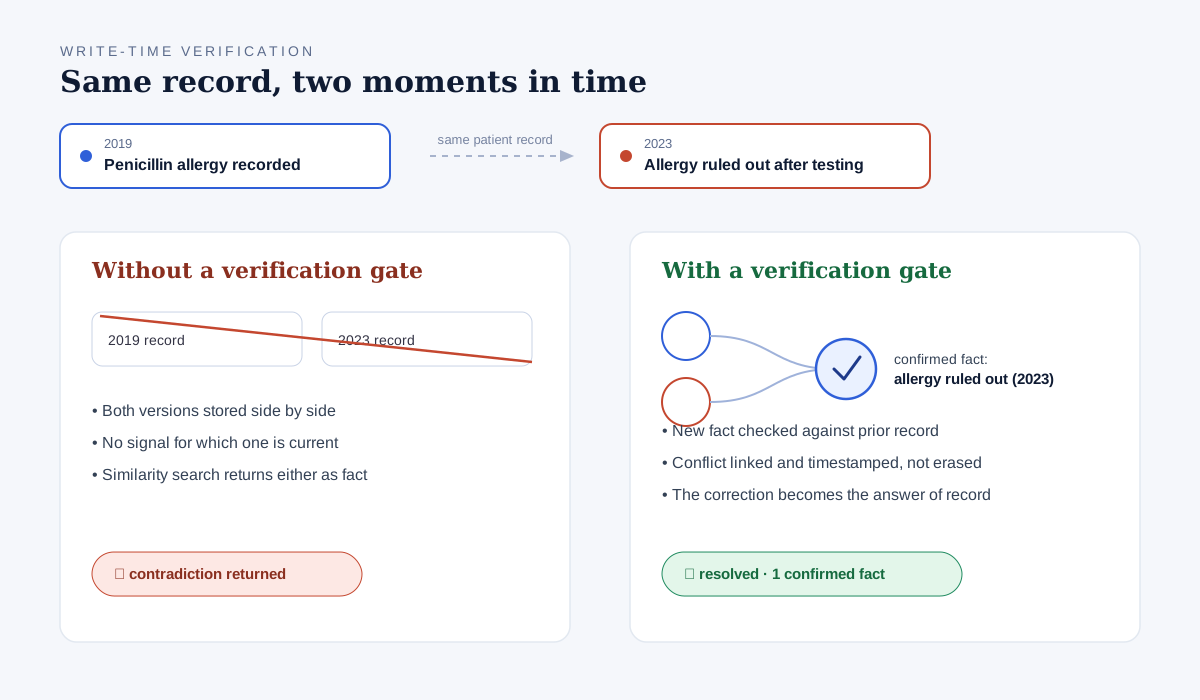 Without a verification gate, two conflicting facts are both stored with no way to tell which one won. A verification gate resolves the conflict the moment the correction arrives.
Append-only temporal versioning. Facts are never mutated in place. Every change is an event; every prior state is preserved and queryable. "What did we know about this counterparty on 14 March?" is a native query, not a forensic reconstruction. For any organization that must defend a decision months or years later, this is the difference between an audit trail and an audit story.
Mapping Memuron to the eight controls
| Control | What the checklist asks for | How Memuron delivers it |
|---|---|---|
| Privacy and minimization | Redact before storage; separate prompt data from memory | Write-time policy gate; nothing persists without passing ingestion rules |
| Auditability | Who, what, when, why, and what the model did | Every answer carries a full provenance chain to source record, timestamp, and ingestion event |
| Retention and deletion | Expiry, legal hold, case-level purge | Partition-scoped retention; append-only ledger makes legal hold native |
| Data residency | Regional, tenant-bound, private deployment | Self-hosted, private VPC, zero-data-retention endpoints, or enterprise private cloud |
| Access control | Permission-aware retrieval at the data layer | Guardian-enforced partition isolation; a query cannot cross a scope it is not authorized for |
| Encryption and keys | In transit, at rest, customer-managed | Inherits the customer's own boundary in self-hosted and private-cloud deployments |
| Model governance | Control what is written and what is recalled | Verification gate on every write and every read; human review hooks for high-risk partitions |
| Tenancy and isolation | Memory bounded by user, team, case, or customer | First-class partitions — case-based memory is the default pattern, not a workaround |
The right-hand column is not a feature list assembled to match a checklist. It is what falls out of building memory as an event-sourced, verification-gated ledger rather than as a searchable pile of embeddings.
The implementation patterns regulated teams actually use — and how Memuron supports them
Mature regulated deployments tend to converge on the same five patterns. Memuron was designed so that each one is a configuration, not a custom build.
Ephemeral-by-default memory. Session context stays transient; only approved information is promoted to long-term memory. In Memuron, promotion is a gated write, and the gate is where policy lives.
Policy-gated long-term memory. Before anything persists: is it sensitive, is it permitted, has it been redacted, does it belong to this case? Memuron runs those checks at write time and adds one the standard pattern omits: does it contradict what we already hold?
Case-based memory. Store at the claim, matter, episode, or case level rather than the user level. Memuron's partitions are case-shaped by design, which is why legal, insurance, healthcare, and investigations teams find the model familiar on day one.
Permission-aware retrieval with source grounding. The assistant can only retrieve what the user is authorized to see, and every response is grounded in source. Memuron enforces authorization at the partition boundary and attaches provenance to every returned fact.
Human-reviewed memory updates. For the highest-stakes contexts, the model proposes and a human approves. Memuron's contradiction links are the natural trigger for that review: when two sources disagree, a person decides and the decision is itself recorded.
The six pitfalls — and why most of them are really one pitfall
Practitioners warn about the same failure modes repeatedly: storing too much, ignoring source permissions, treating embeddings as harmless, having no deletion story, weak observability, and over-customizing before governance is stable.
Look closely and five of the six share a root cause: the memory layer was treated as storage, and governance was assembled around it afterward. Redaction bolted on. Permissions checked in the prompt instead of the data layer. Deletion designed after launch. Logs added when the first audit request arrived.
Memuron inverts that order. The governance properties which are provenance, partition isolation, contradiction detection, temporal versioning, refusal — are the data structure. There is no version of Memuron without them, which is why there is nothing to bolt on and nothing to forget.
The sixth pitfall is over-customizing too early. This is the one we agree with most strongly. Start with one bounded use case. Prove the controls. Then expand. Every Memuron engagement begins that way: a single partition, a single workflow, measurable outcomes, and a decision on expansion made on evidence rather than enthusiasm.
The tipping point
There is a moment in every regulated deployment that changes the economics permanently. It is the first time a point-in-time reconstruction from the memory ledger is relied on in a regulated deliverable like a clinical audit, a regulatory filing, a court submission, a quality inspection.
After that moment, the memory layer is no longer infrastructure. It is part of the organization's evidentiary record. Switching to a system without append-only versioning and full provenance would break the continuity of that record and no buyer can retroactively fill an audit gap.
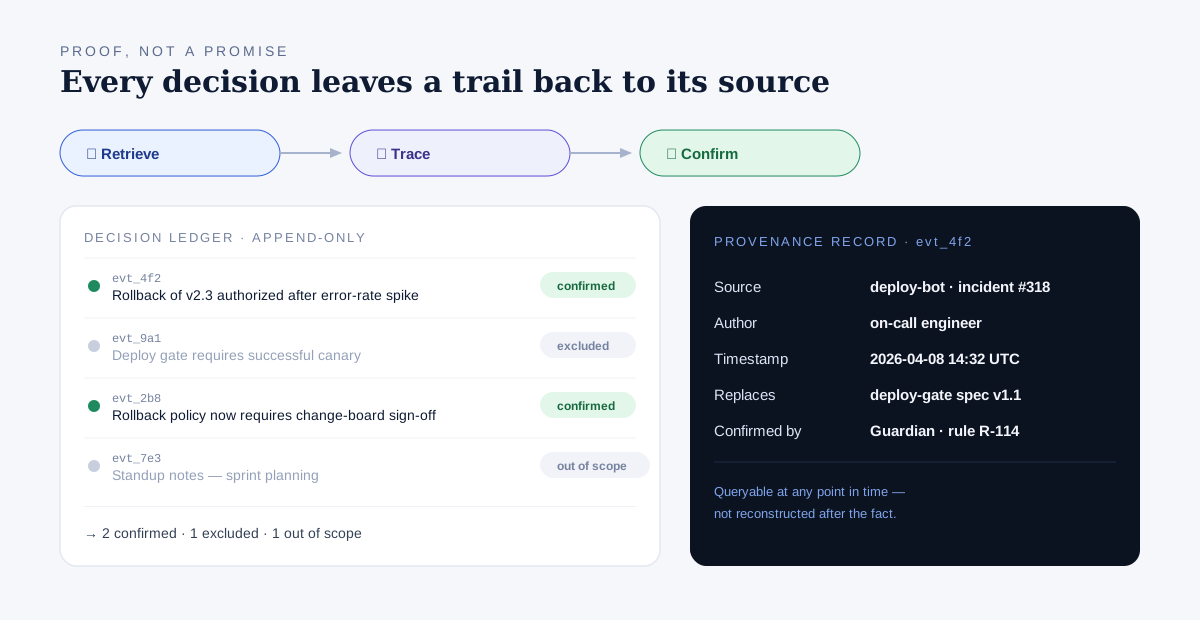 Every decision record is confirmed, excluded, or out of scope — traceable back through the sources and corrections that produced it, not reconstructed after the fact
That is the real reason regulated industries need memory built for precision. Not because governance checklists demand it, though they do. Because the moment AI output is relied upon, the question "how do we know this is true?" stops being a product question and becomes a legal one.
Memuron was built so the answer is always the same: here is the evidence, here is its history, and here is where the evidence ran out.
 One of Memuron's active pilots: giving a semiconductor manufacturing line a verified, auditable memory of every process decision
AlphaNimble Technologies LLP builds Memuron, verification-gated AI memory infrastructure for regulated enterprises. Memuron is in active pilots across semiconductor manufacturing and financial-services assurance, and is available for self-hosted, private-cloud, and zero-data-retention deployment.