
Can AI Chatbots Address the Global Mental Health Support Gap in 2027? Technology, Opportunities and Industry Challenges
Published on November 11, 2026
·4 min read
Can AI Chatbots Address the Global Mental Health Support Gap in 2027? Technology, Opportunities and Industry Challenges
Overview
Limited healthcare resources, high treatment costs and a shortage of mental health professionals leave millions without timely support.
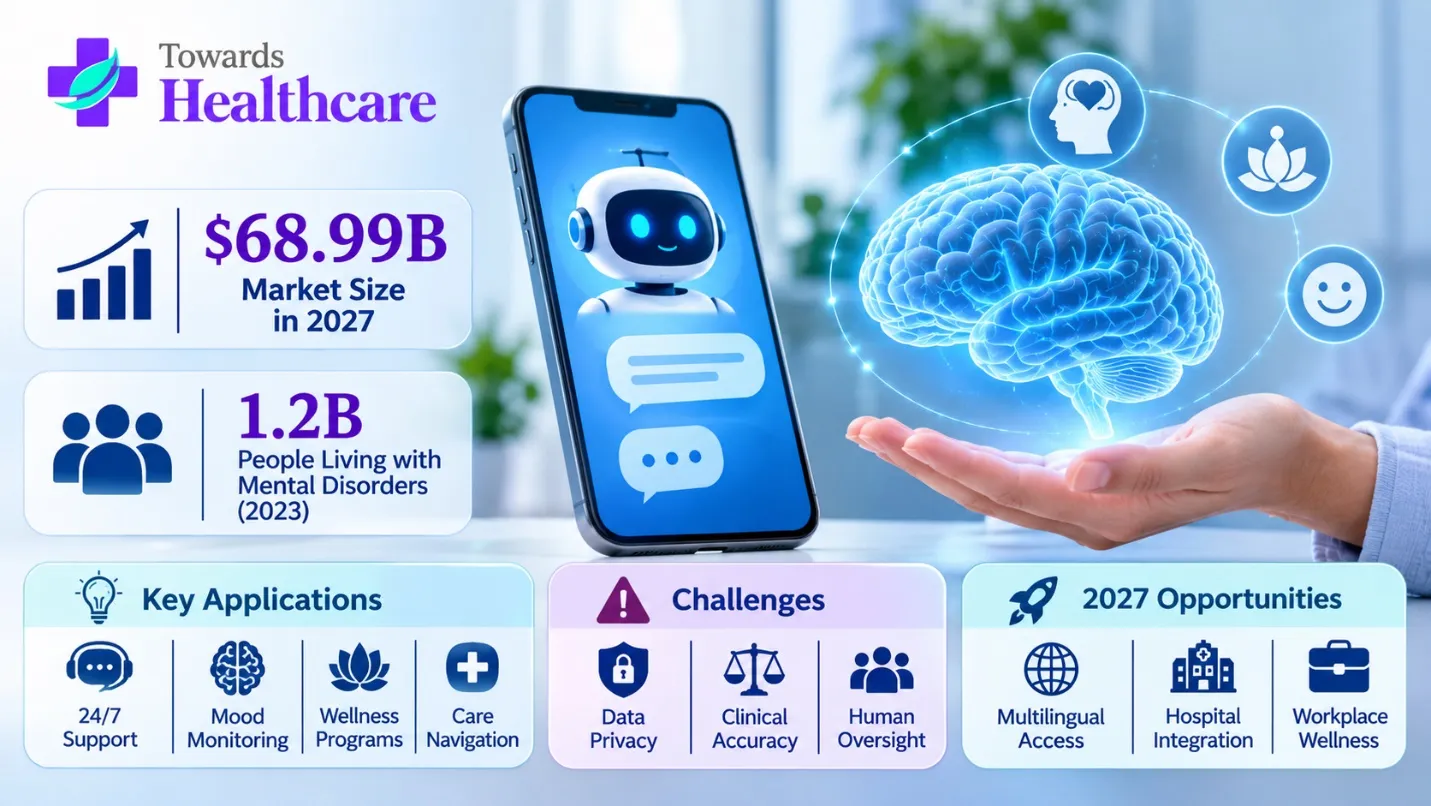
According to the WHO, 1.2 billion people lived with a mental disorder in 2023, nearly one in seven worldwide. Most do not receive effective care.
AI-powered chatbots use natural language processing (NLP), machine learning and generative AI to offer guided conversations, emotional check-ins, stress-management exercises and mental health information. In 2027, these tools could expand access to basic support, but their success will depend on clinical evidence, patient safety, data privacy and human supervision.
From Basic Chatbots to Generative AI
Early chatbots, such as ELIZA, followed predefined scripts to simulate conversations. Later platforms introduced CBT-based exercises, mood tracking and guided self-help.
Generative AI now enables more natural, context-aware conversations, but responses can still be inaccurate or unsafe.
A 2025 World Psychiatry review of 160 studies found that LLM-based chatbots accounted for 45% of new studies in 2024. However, only 16% of these studies tested clinical effectiveness.
Current Industry Situation
AI mental health chatbots are gaining attention from digital health companies, healthcare providers and investors. They offer round-the-clock digital support and may help with initial patient engagement.
A 2025 Journal of Medical Internet Research review analysed 26 studies, including 14 randomised controlled trials with 6,314 participants. It found a small but statistically significant improvement in mental health outcomes, while highlighting the need for stronger evidence and safety research.
Beyond standalone apps, opportunities include patient engagement, digital counselling support, workplace wellness and telehealth integration.
However, natural-sounding conversations do not guarantee clinically effective care. Chatbots should complement, not replace, qualified mental health professionals.
AI chatbots in mental health industry will grow 124.79 billion in next decade, according to Towards Healthcare study
AI Mental Health Chatbots: Technologies and Their Healthcare Applications
Technology | Potential application |
Natural Language Processing | Understand user questions and emotional language |
Generative AI | Support personalised conversations |
Machine Learning | Identify patterns in user-reported information |
Sentiment Analysis | Recognise possible emotional changes |
Voice AI | Enable speech-based interactions |
Predictive Analytics | Support risk assessment when clinically validated |
Key applications include:
- 24/7 emotional support: Offer basic guidance when professional support is not immediately available.
- CBT-based exercises: Deliver structured activities for stress management and coping skills.
- Mood monitoring: Help users record emotional changes and identify patterns.
- Patient engagement: Support follow-up communication between clinical appointments.
- Workplace wellness: Give employees access to structured mental health resources.
- Care navigation: Help users identify suitable mental health services and professional support.
These applications can support healthcare delivery, but they should not replace clinical diagnosis, psychotherapy or emergency intervention.
Challenges for AI Mental Health Chatbots Over the Next Decade
- Clinical accuracy: Preventing misleading responses, incorrect assessments and missed symptoms.
- Data privacy: Protecting sensitive conversations, medical records and personal information.
- Crisis detection: Identifying suicidal thoughts, self-harm risks and severe mental health conditions, with timely human intervention.
- Human connection: Maintaining empathy and ensuring chatbots complement rather than replace professional care.
- Regulatory compliance: Meeting evolving healthcare regulations, safety standards and ethical requirements.
- Algorithmic bias: Ensuring reliable support across different languages, cultures, age groups and communities.
- Overdependence on AI: Preventing users from relying on chatbots instead of seeking qualified professional help.
- Long-term effectiveness: Proving that chatbot support delivers safe, measurable benefits beyond short-term improvements.
- Integration with healthcare systems: Connecting AI tools securely with hospitals, therapists and existing care pathways.
- Accountability: Establishing who is responsible when an AI chatbot provides harmful or inappropriate guidance.
2027 Opportunities
1. AI-assisted mental health screening
Healthcare providers could use conversational tools to collect initial patient information, identify reported concerns and guide users towards appropriate clinical assessments. These tools must support, rather than independently replace, professional diagnosis.
2. Multilingual mental health platforms
India, Southeast Asia, Africa and Latin America offer opportunities for chatbots that communicate in regional languages. Voice-based interfaces could also help people who struggle with written communication or digital literacy.
3. Integration with hospitals and telehealth
Hospitals and digital healthcare companies could integrate chatbots into appointment systems, patient follow-ups and counselling programmes. This could improve communication between appointments and help clinicians organise patient-reported information.
4. AI-powered workplace wellness
Employers could introduce digital mental health platforms that provide stress-management resources, guided exercises and confidential access to professional support. This creates opportunities for healthcare technology providers and enterprise wellness companies.
5. Clinical validation and specialised AI models
The next opportunity lies in developing mental health models trained and evaluated for specific clinical applications. Companies that demonstrate measurable outcomes, strong privacy protection and reliable safety systems could gain greater acceptance among healthcare organisations.
Will 2027 Be a Turning Point for AI Mental Healthcare?
AI chatbots could become an important part of digital mental health delivery in 2027, particularly in areas where people struggle to access timely support. Their ability to provide continuous interactions, multilingual communication and structured self-help creates opportunities for healthcare providers and technology developers.
However, the future will not depend on how naturally an AI chatbot communicates. Clinical evidence, patient safety, data protection and human supervision will determine whether healthcare organisations can trust these platforms.
The strongest opportunity lies in combining AI accessibility with professional mental healthcare, creating a system where technology helps more people reach the support they need.
About Author
Payal Rabde is a Healthcare Market Research Analyst at Towards Healthcare Research & Consulting with over 4+ years of experience in pharmaceutical, biotechnology, medical device, and healthcare market research. She holds an MBA in Pharmaceutical-Biotechnology Management and a B.Pharm, specializing in market analysis, forecasting, competitive intelligence, and strategic healthcare insights.
Payal Rabde
LinkedInPayal Rabde is a Healthcare Market Research Analyst at Towards Healthcare Research & Consulting with over 4+ years of experience in pharmaceutical, biotechnology, medical device, and healthcare market research. She holds an MBA in Pharmaceutical-Biotechnology Management and a B.Pharm, specializing in market analysis, forecasting, competitive intelligence, and strategic healthcare insights.